
Why No One Notices the Monsters: The Psychology of Urban Fantasy
Why No One Notices the Monsters: The Psychology of Urban Fantasy
By Neal Martin/ February 11, 2026
Last Updated February 11, 2026
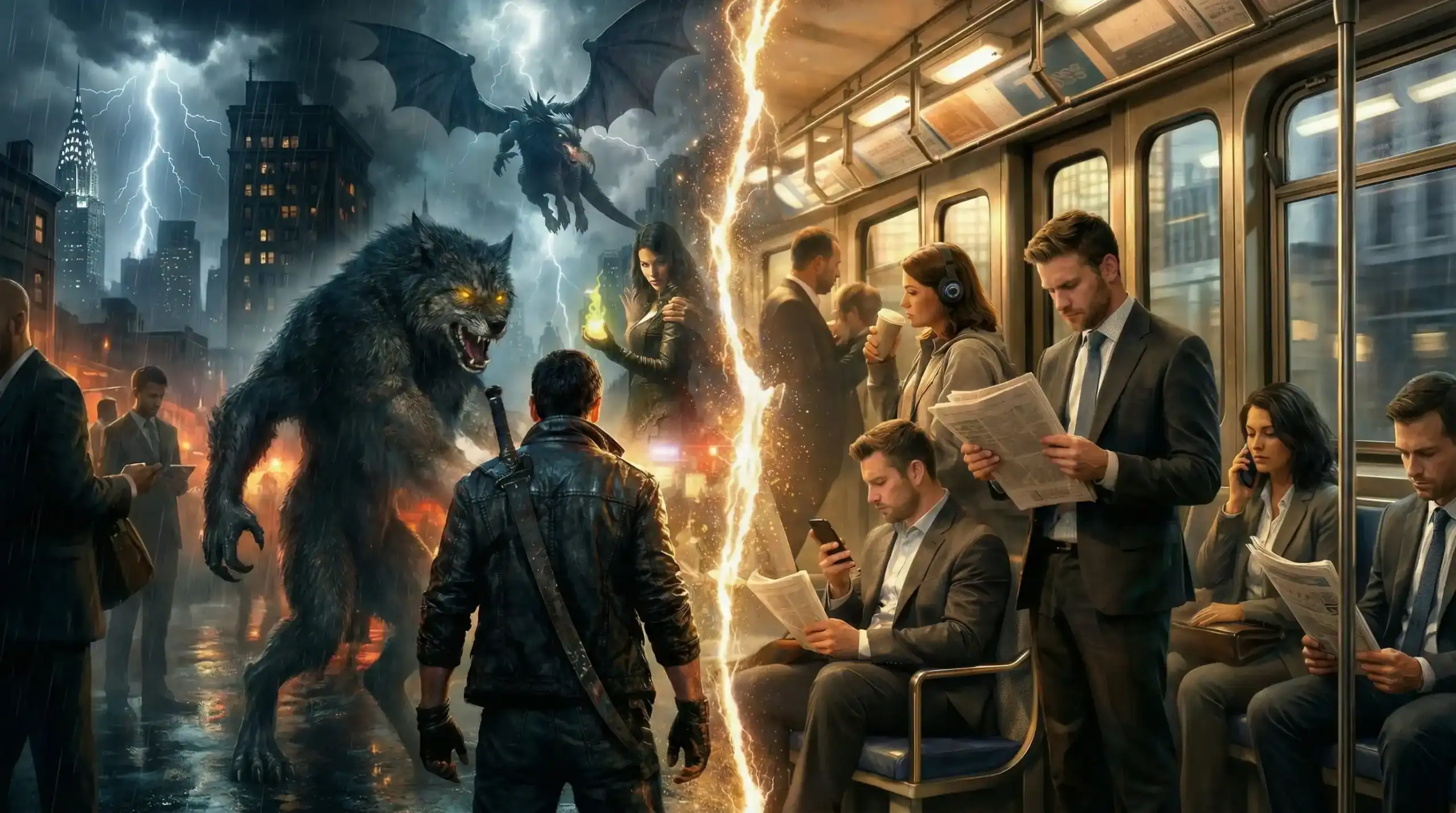
One of the most persistent questions I get from readers of urban fantasy—and especially from those new to the genre—is a variation of the same logistical puzzle:
How can all of this exist without everyone noticing?
They point to the monsters. The magic. The sudden disappearances. The blood on the pavement that somehow vanishes by morning or gets washed away by rain before the crime scene tape goes up. Surely, they argue, someone would see it. Surely people would ask the hard questions. Surely the world would wake up.
It’s a fair critique. In an age of smartphones, surveillance cameras, and 24-hour news cycles, the idea of a “Masquerade”—a secret magical world hidden within our own—can feel like a narrative cheat. I’ve asked myself the same thing more than once while building the lore for the Drake series.
In my books, the mechanism is simple on the surface: there are Awares and there are Unawares.
The Unawares go about their lives exactly as we do. They work, commute, scroll through social media, argue about politics, worry about rent, drink too much coffee, and try to get through the day. They have absolutely no idea what is really happening in the shadows of their cities.
The Awares, on the other hand, know the truth. They know what lives in the dark.
But here is the part that unsettles people, the part that moves this from a fantasy trope to something darker: sometimes an Unaware does glimpse the truth—and they still choose to ignore it.
They explain it away. They forget. They tell themselves it was stress, exhaustion, a trick of the light, or a bad reaction to medication. They edit their own memories in real-time.
Why? Because accepting the truth would cost too much.
The Cost of Believing
We like to think of ourselves as seekers of truth. We imagine that if we saw a dragon perch on the Shard or a vampire feed in an alleyway, we would immediately film it, post it, and start a revolution.
But psychology suggests otherwise. To admit that the supernatural exists is to admit that the world is not what you were told it was. It means admitting that the rules of physics, safety, and society are optional. It means acknowledging that there are things lurking just out of sight that view you not as a citizen, but as prey.
That realization shatters the safety of the “known world.” And most people, when faced with the choice between a terrifying truth and a comforting lie, don’t become heroes.
They become deniers.
Even as the author, I used to worry that this stretched credibility too far. Surely, I thought, people would wake up. Surely they’d push back. Surely they’d demand answers.
But then you look at the real world. Especially now.
The Real-World Veil
In light of current events and the recent release of certain government files, something uncomfortable has become crystal clear: Human beings are exceptionally good at ignoring things that threaten their sense of normality.
We are watching a real-time lesson in cognitive dissonance. We see documents released, facts laid bare, and hideous truths exposed about powerful figures or institutions—and what happens? Does society grind to a halt? do we storm the gates?
For a moment, perhaps, there is outrage. But then the news cycle turns. The discomfort becomes too heavy to carry. We filter reality. We overlook contradictions. We accept half-truths because the full truths would force us to dismantle our entire worldview.
People don’t ignore reality because they’re stupid. They ignore it because acknowledging it would require action.
If you admit the monster is real, you have to fight it. If you admit the conspiracy is true, you have to dismantle the system. That is exhausted work. It is dangerous work.
That is why the Unawares don’t storm the gates of the supernatural world in my books. That is why they don’t form mobs or demand revelations or blow the whole thing wide open. They look away because looking away allows them to go to work on Monday morning and pretend everything is fine.
Urban Fantasy as Psychological Realism
This is why I argue that urban fantasy isn’t just escapism. If anything, it might be one of the most honest genres on the shelves right now.
High fantasy takes you to a new world with new rules. But urban fantasy keeps you in this world and asks a much more intrusive question. It doesn’t ask, “What if magic existed?”
It asks, “What if the truth was right in front of you—and you chose not to see it?”
In the Drakeverse, the magic isn’t hidden because of some high-tech invisibility shield or a government neuralyzer. The monsters aren’t hidden because they are impossible to see.
They are hidden because people do not want to know.
The barrier between the Awares and the Unawares isn’t magic; it’s denial. It is the human capacity to normalize the abnormal to preserve our sanity.
So, when you read about a dragon shifter walking down a London street unnoticed, or a crime scene that makes no sense being filed away as a “gas leak,” don’t think of it as a plot hole. Think of it as a mirror.
The monsters are there. We just got very, very good at looking the other way.
And that, I’d argue, is far more believable—and far more terrifying—than any spell, curse, or secret society.

LATEST RELEASE

LATEST POSTS


HIRE MY COVER DESIGNER!

STUFF I WRITE ABOUT
Audiobooks Author Updates Blogging Book Cover Design Characters Clive Barker Conspiracies Dark Fantasy Fiction Dark Fiction Dark Urban Fantasy Deadson Confidential Drakeverse Ethan Drake Series Fiction Writing H.R. Giger Hellblazer Horror Humor Influences Internet John Constantine Marketing Mastery Motivation Movies Music Mythology Negativity Non-Fiction Writing Personal Development Productivity Purpose Reviews Sandman Slim Self-Publishing Short Stories Social Media Spirtuality Subconcious Tropes TV Shows Urban Fantasy Writer's Doubt Writing Writing Voice
Leave a Reply